Imagine your perfect escape. How does it look like? White houses, the turquoise sea, hot summer, sipping cocktails all day long? Well, heaven exists and it’s called „Greek Islands“. On Mykonos you can feel magic of the best nightlife in the whole world; Go to Skiathos and visit famous „Banana“ beach where you can party all day, if so not go to one of the top 10 most exotic beaches in the world – „Lalaria“; Get to know history of Rhodes; Experience without an unprecedented the most beautiful sea color on Crete; Live fairytale on Santorini; In Paros be elegant; Party with Italians on Ios, then rest on Samos; On the other side of Greece, meet the happy British in Zakynthos and discover Corfu. Find out what’s your version of heaven and enjoy.
Showing posts with label Amazing Picture. Show all posts
Monday, 5 March 2012
Tuesday, 28 February 2012
Monday, 13 February 2012
Monster Mummies of Japan
Lurking in the halls of Buddhist temples and museums across Japan are a host of monster mummies -- the preserved remains of demons, mermaids, kappa, tengu, raijū, and even human monks. Here are a few remarkable specimens for the adventurous and brave at heart.
- Demon mummies
It might seem odd that Buddhist temples in Japan house the occasional stray mummified demon (oni), but then again it probably makes sense to keep them off the streets and under the watchful eye of a priest.
Zengyōji (善行寺) temple in the city of Kanazawa (Ishikawa prefecture) is home to the mummified head of a three-faced demon. Legend has it that a resident priest discovered the mummy in a temple storage chamber in the early 18th century. Imagine his surprise.
Nobody knows where the demon head came from, nor how or why it ended up in storage.
The mummified head has two overlapping faces up front, with another one (resembling that of a kappa) situated in back. The temple puts the head on public display each year around the spring equinox.
Another mysterious demon mummy can be found at Daijōin temple in the town of Usa (Oita prefecture).
The mummy is said to have once been the treasured heirloom of a noble family. But after suffering some sort of misfortune, the family was forced to get rid of it.
The demon mummy changed owners several times before ending up in the hands of a Daijōin temple parishioner in 1925. After the parishioner fell extremely ill, the mummy was suspected of being cursed.
The parishioner quickly recovered from his illness after the mummy was placed in the care of the temple. It has remained there ever since. Today the enshrined demon mummy of Daijōin temple is revered as a sacred object.
A much smaller mummy -- said to be that of a baby demon -- was once in the possession of Rakanji Temple at Yabakei (Oita prefecture).
Unfortunately, it was destroyed in a fire in 1943.
- Mermaid mummies
In Edo-period Japan -- particularly in the 18th and 19th centuries -- mermaid mummies were a common sight at popular sideshow carnivals called misemono. Over time, the practice of mermaid mummification blossomed into an art form as fishermen perfected techniques for stitching the heads and upper bodies of monkeys onto the bodies of fish.
The mummified creature was obtained by Jan Cock Blomhoff while serving as director of Dejima, the Dutch trading colony at Nagasaki harbor, from 1817 to 1824. It now resides at the National Museum of Ethnology in Leiden.
Another old mermaid mummy exhibited at a museum in Tokyo several years ago appears to belong to the founder of the Harano Agricultural Museum.
The mummy pictured below is a prime example of a carnival mermaid. It appears to consists of fish and other animal parts held together with string and paper.
The mummy's origin is unknown, but the collector says it was found in a wooden box that contained passages from a Buddhist sutra written in Sanskrit. Also in the box was a photograph of the mermaid and a note claiming it belonged to a man from Wakayama prefecture.
- Kappa mummies
Like the mermaid mummies, many kappa (river imp) mummies are thought to have been crafted by Edo-period artists using parts of animals ranging from monkeys and owls to stingrays.
This mummified kappa, which now resides in a Dutch museum, appears to consist of various animal parts put together in a seamless whole. It is believed to have been created for the purpose of carnival entertainment in the Edo period.
The ancient fortress on an island in Siberia
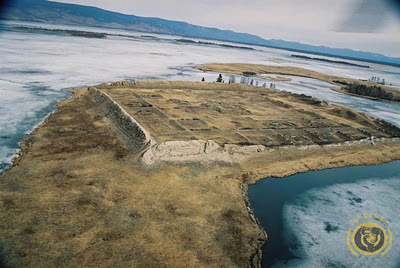
Deep within the Siberia there is a lake which is just one among thousands of others. In the center of that lake there is a small island. On that island people excavated the remains of an ancient fortress, which dates from 1500. A lot more excavations need to be done so that the Fortress can become a tourist attraction, but still, from the air, it's beautiful at any time of the year. The first set of pictures was taken during the short Siberian summer:
Subscribe to:
Posts (Atom)